
If you decorate clothing in the UK, you’ve heard people talking about DTF. It’s gone from a niche curiosity to the default method for a lot of small print businesses in just a few years — and for good reason.
This guide explains what direct-to-film printing actually is, how the process works, what it costs, and where it beats the alternatives. No jargon, no sales pitch.
The short version
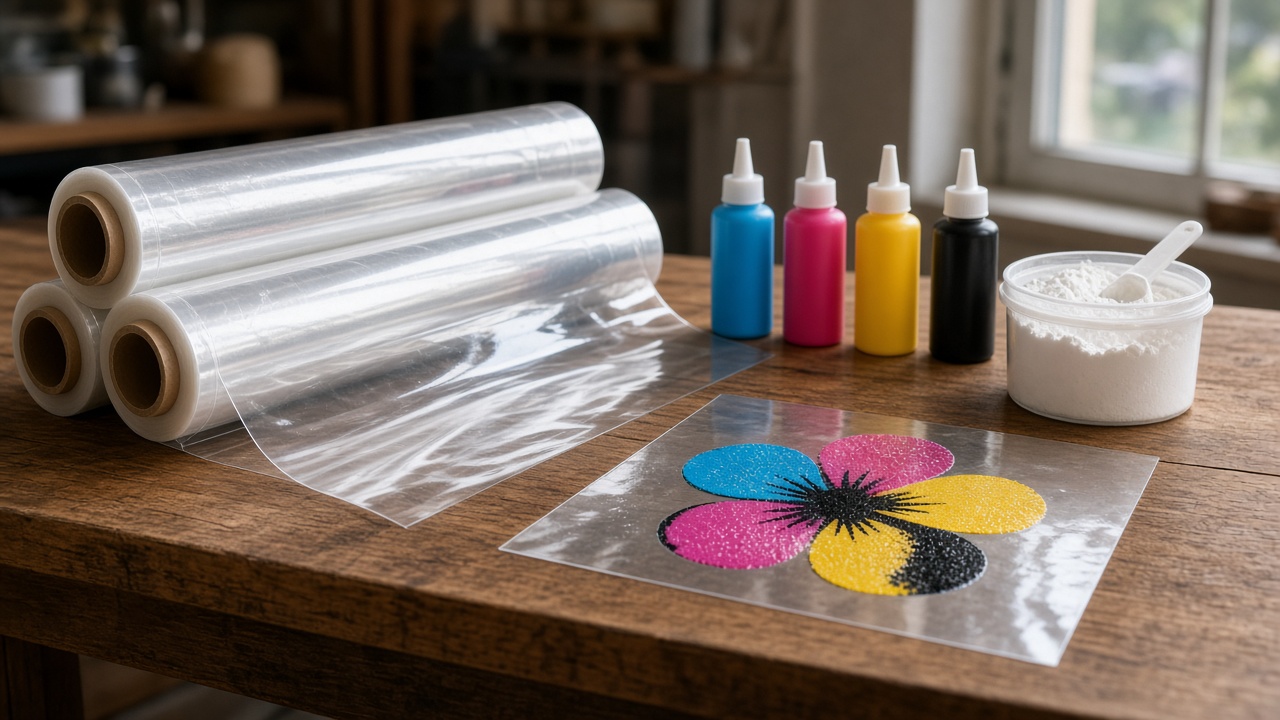
DTF stands for direct-to-film. Instead of printing onto a garment, you print your design onto a special PET film, coat it with an adhesive powder, cure it, and then heat press it onto the fabric.
The result is a full-colour print that works on almost any fabric, in any colour, with no weeding, no cutting, and no minimum order.
That last part is what changed the game. You can print one shirt profitably.
How the process works
There are five stages. If you buy ready-made transfers, someone else handles the first four and you only do the last one.
1. Print the design
A DTF printer lays down CMYK colour first, then a layer of white ink behind it. That white underbase is what lets the design show up properly on black and dark garments — something ordinary inkjet transfers can’t do.
2. Apply adhesive powder
While the ink is still wet, a hot-melt adhesive powder is applied across the printed area. The powder sticks only to the wet ink, not the blank film.
3. Cure the powder
The film goes through a dryer or curing oven for a couple of minutes. The powder melts into a smooth, slightly tacky layer. This is the glue that will eventually bond to the fabric.
4. Store or ship
Cured transfers are stable. They keep for months in a cool, dry place out of direct sunlight, so you can print in batches and press on demand.
5. Heat press onto the garment
Pre-press the garment, position the transfer, press at around 160°C for 10–15 seconds with firm pressure, peel the film, then press again briefly to finish. That second press matters more than most people realise.
What makes DTF different
It works on almost anything. Cotton, polyester, blends, canvas, denim, fleece, nylon, leather. Sublimation only works on white or light polyester. DTF has no such restriction.
Dark garments are no problem. The white ink underbase means a black hoodie prints as cleanly as a white tee.
No weeding. Anyone who’s spent an evening picking tiny letters out of vinyl will appreciate this. DTF transfers come off the film exactly as printed.
No minimum order. Screen printing needs a screen per colour, so short runs are uneconomic. DTF costs roughly the same per print whether you make one or fifty.
Full colour, including gradients and photos. Detail that would be painful in vinyl or screen print is straightforward.
Durability is genuinely good. A properly applied transfer will comfortably survive 50+ washes, and a well-executed one can reach around 100. Most failures come down to application, not the transfer itself.
Where DTF isn’t the right answer
Being honest about the limits saves you money:
- Very large runs of a simple one-colour design. Screen printing gets cheaper the more you print. At a few hundred units of a single-colour logo, screens win.
- All-over sublimation on white polyester. Sublimation dyes the fabric itself, so there’s zero hand-feel. DTF sits on top.
- Waterproofed or coated fabrics. DWR shells, silicone-backed material and heavily treated fabrics repel the adhesive. Embroidery or a patch is the better call.
- Very heavy stretch areas. DTF has some give, but a design placed across a high-stretch panel will crack eventually.
DTF vs the alternatives
DTF vs sublimation
Sublimation gives an unbeatable soft feel with no texture at all — but only on white or pale polyester. DTF works on any fabric and any colour. If you print on cotton or dark garments, sublimation simply isn’t an option.
DTF vs screen printing
Screen printing wins on very large runs and on speciality inks. DTF wins on short runs, full-colour artwork, and setup time. Most small UK print businesses use DTF for everything under about 50–100 pieces.
DTF vs DTG
DTG prints straight onto the garment and gives an excellent soft hand on cotton. But DTG machines are expensive, need constant maintenance, and struggle on polyester. DTF is cheaper to get into and far more flexible on fabric.
DTF vs heat transfer vinyl
Vinyl is fine for simple one-colour text. Anything with detail or multiple colours becomes slow and fiddly. DTF handles complex artwork in one press.
What does DTF cost to get started?
You’ve got two routes.
Buy ready-made transfers. Zero equipment beyond a heat press. You send artwork, transfers arrive ready to press. Gang sheets — where you fit many designs onto one sheet — bring the cost per print right down. This is how most people start, and plenty of businesses never move past it because the maths works.
Print your own. You’ll need a DTF printer, film, inks, adhesive powder, a curing unit and a heat press. Higher upfront cost and a real learning curve (white ink needs regular maintenance or it clogs), but the per-print cost drops significantly at volume.
The honest advice: start by buying transfers. Prove there’s demand, learn what sells, then buy a printer once you’re pressing enough volume to justify it.
What you need to press transfers
- A proper heat press. Not an iron. Irons have uneven heat, no accurate temperature control and no consistent pressure.
- A pressing pillow for hoodies, totes and anything with seams.
- Parchment or a silicone sheet for the second press.
- An infrared thermometer or test strips to check your press is actually running at the temperature it claims. Most aren’t.
Common beginner mistakes
Skipping the pre-press. Moisture in the fabric turns to steam under the platen and stops the adhesive bonding. Three to five seconds fixes it.
Not enough pressure. If your press closes easily with one hand, it’s too light. This is the single most common cause of prints peeling in the wash.
Skipping the second press. This is what embeds the adhesive into the fibres. Skip it and prints look fine at first, then fail around the tenth wash.
Pressing polyester too hot. Above about 150°C, dye from the fabric can gas into your white ink and turn the print pink or grey — often a day later, after you’ve shipped it.
Trusting the temperature display. Presses drift. Check with a thermometer or test strips.
Is DTF right for your business?
DTF suits you if you sell short runs, print on varied fabrics, take custom one-off orders, or want full-colour artwork without setup costs. That covers most Etsy sellers, print-on-demand shops, workwear suppliers, club and team kit, and small local print businesses.
If you’re running thousands of identical single-colour prints, screen printing still has its place.
Getting started
We supply ready-to-press DTF transfers and gang sheets with no minimum order, plus film, inks, powders, printers and heat presses if you decide to bring printing in-house.
New to it? Order a sample pack and try pressing before you commit to anything.

